Showing posts with label Markets. Show all posts

Sunday, 7 June 2009

Market moves 1-5 June 2009

The pound reached 7 month highs against the dollar and the Euro, before falling away towards the end of the week (the BBC suspected it was the political instability here, I'm not convinced).

Anyway, the bare facts are below:

FTSE: 4438.56 (up 20.62 or 0.47% in 1 week, 25.71% in 13 weeks)
DOW: 8763.13 (up 262.80 or 3.09% in 1 week, 32.23% in 13)
£/$: 1.5982 (down 2.06¢ or 1.27% in 1 week, up 13.43% in 13)
£/€: 1.1440 (up 0.04¢ or 0.03% in 1 week, 2.71% in 13)

Oil in $: 68.37 (up $2.63 or 4.00% in 1 week, 56.35% in 13)
Oil in £: 42.78 (up £2.17 or 5.34% in 1 week, 37.84% in 13)
Oil in €: 48.94 (up €2.50 or 5.38% in 1 week, 41.57% in 13)

Gold in $: 962 (down $13 or 1.38% in 1 week, up 2.78% in 13)
Gold in £: 601.93 (down 68p or 0.11% in 1 week, 9.39% in 13)
Gold in €: 688.60 (down 54¢ or 0.08% in 1 week, 6.93% in 13)

All the usual good news signals, except that the pound fell against the dollar (or rather, the dollar rose against the Euro and pound, perhaps indicating a shift in perceptions as to the consequences of recovery on the value of the dollar in the longer term).

It is notable that the oil price and stock markets have shifted far more than gold and the currencies have. That gold hasn't fallen proves that many aren't convinced that "everything is going to be okay" but demand for oil is recovering, which means that the restrictions put into place by OPEC (to limit the oil price collapse) will start to bite.

Sunday, 31 May 2009

Markets 25-29 May 2009

A less dramatic version of last week's news, with small increases in everything (except oil, which continued its rise). Here are the figures, comparing Friday's close with the close a week earlier. I also include the last weekend when each indicator was last higher (this will differ from the data quoted on news channels, as they will use minute-by-minute data for comparison, not weekly).

FTSE: 4417.94 (up 42.65 or 1.21%) - was higher on 10/05/2009 (3 weeks)
DOW: 8500.33 (up 223.01 or 2.69%) - was higher on 10/05/2009 (3 weeks)

£: $1.6188 (up 2.68¢ or 1.68%) - was higher on 02/11/2008 (30 weeks)
£: €1.1436 (up 0.67¢ or 0.59%) - was higher on 08/02/2009 (16 weeks)

Oil: $65.74 (up $5.11 or 8.43%) - was higher on 02/11/2008 (30 weeks)
Oil: £40.61 (up £2.53 or 6.63%) - data not available before 7/12/2008 (25 weeks)
Oil: €46.44 (up €3.14 or 7.26%) - data not available before 7/12/2008 (25 weeks)

Gold: $975.5 (up $15.75 or 1.64%) - was higher on 22/02/2009 (14 weeks)
Gold: £602.61 (down 25p or 0.04%) - was higher last week, lower 3 weeks ago
Gold: €689.14 (up €3.75 or 0.55%) - was higher on 29/03/2009 (9 weeks)

That both the £/$ and Oil/$ exchange rates are at 30-week highs is no coincidence. Next week, I will compare prices with 13 weeks earlier, since that marks 3 months since the "rally" began in the markets.

Monday, 25 May 2009

Markets: 18-22 May 2009

A delayed post, but this tracks movements between Friday close (15 May) and Friday close (22 May). Major movements were on currencies rather than stock markets.

FTSE: 4365.29 (up 17.18 pts, 0.40%)
DOW: 8277.32 (up 8.68 or 0.10%)
£: $1.592 (up 7.41¢ or 4.88%)
£: €1.1369 (up 1.28¢ or 1.14%)
Oil: $60.63 (up $4.56 or 8.13%)
Oil: £38.08 (up £1.14 or 3.10%)
Oil: €43.30 (up €1.77 or 4.27%)
Gold: $959.75 (up $30.25 or 3.25%)
Gold: £602.86 (down £9.50 or 1.55%)
Gold: €685.39 (down €2.96 or 0.43%)

Put simply, the dollar fell dramatically, but the stock markets were unfazed. Of course, in dollar terms, the FTSE rose over 5%, but since that isn't how it is measured, it doesn't get mentioned in the news (in £ terms, the DOW fell over 4.5%).

My point about oil price shifts being less dramatic when measured in pounds remains true.

Saturday, 16 May 2009

Markets 11-15 May 2009

Bad news this week, but not on the scale we became accustomed to over the winter. Below are listed the Friday closing levels of several markets, and a comparison with their levels one week earlier - designed to eliminate "noise" from daily data you might hear on the news).

FTSE: 4348.11 (down 113.98 pts or 2.55%)
DOW: 8268.64 (down 306.01 pts or 3.57%)

£: $1.5179 (down 0.51¢ or 0.33%)
£: €1.1241 (up 0.73¢ or 0.65%)

Oil: $56.07 (down $2.12 or 3.64%)
Oil: £36.94 (down £1.27 or 3.32%)
Oil: €41.52 (down €1.15 or 2.69%)

Gold: $929.50 (up $22.50 or 2.48%)
Gold: £612.36 (up £16.82 or 2.83%)
Gold: €688.35 (up €23.26 or 3.50%)

In italics is the only measure that doesn't match the glum mood. Stock markets rise with good news, as does the pound (perceived as more vulnerable to a struggling world economy) and so does oil (implied increased demand) whereas gold falls (implied decline in instability).

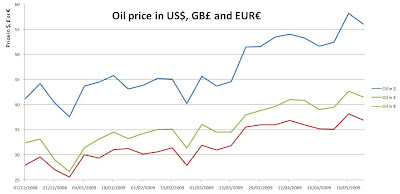
Below is a graph which I hope demonstrates the correlation between oil and the pound. See how, especially over the past two months, the oil price as measured in pounds is more stable than the others.

Saturday, 9 May 2009

Markets 4-8 May 2009

A good week on the markets as confidence begins to return.

FTSE: 4462.09 (up 218.87 or 5.2%)
DOW: 8574.65 (up 362.24 or 4.4%)
£: $1.5230 (up 3.19¢ or 2.1%)
£: €1.168 (down 0.71¢ or 0.6%)
Oil: $58.19 (up $5.77 or 11.0%)
Oil: £38.21 (up £3.05 or 8.7%)
Oil: €42.67 (up €3.16 or 8.0%)
Gold: $907 (up $22.5 or 2.5%)
Gold: £595.64 (up £2.35 or 0.4%)
Gold: €665.09 (down €1.59 or 0.2%)

Big increase in the price of oil (sign of confidence), in the UK stock market (given that, in dollar terms it went up almost 7.5%) and several other indicators of economic well-being.

Despite this, you cannot say the worst is over. A similar rally occured in 1931. Only time will tell when this is over, but last week was 4th in a row where the FTSE rose, and the 8th in 9. Fear is passing, perhaps giving the current market levels a better scale of realism, as the "panic" of February seems to pass. Of course, come June, we might find a different story.

Saturday, 2 May 2009

Markets this week

Swine flu became a global obsession, it was announced that the US economy was still shrinking faster than 6% a year (meaning it is currently about 3.3% below its peak) and as ever there was much bad news all around.

None of it appears to have surprised the markets, however. Here's the current levels and their change on a week earlier.

FTSE: 4243.22 (up 87.23, or 2.1%)
DOW: 8212.41 (up 136.12 or 1.7%)
£: $1.4911 (up 2.39¢ or 1.6%)
£: €1.1239 (up 1.56¢ or 1.4%)
Oil: $52.42 (up 76¢ or 1.5%)
Oil: £35.36 (down 6p or 0.2%)
Oil: €39.51 (up 49¢ or 1.3%)
Gold: $884.5 (down $23 or 2.5%)
Gold: £593.19 (down £25.34 or 4.1%)
Gold: €666.68 (down €18.83 or 2.7%)

Interestingly, the movement in the DOW and the £/$ exchange rate have been remarkably similar of late. If the DOW were measured in £ terms, it would lie 11.3% below it's 03/01/2009 peak, compared to 11.4% last week, 11.5% the week before and 11.2% three weeks ago. This is a highly unusual correlation, but implies that any optimism about the US economy either weakens the dollar or strengthens the pound. It also means that in any common currency, the FTSE has outperformed the DOW recently. Graph below, of both indices, quoted in £, rebased so that their recent peak is set at 100.

Tuesday, 28 April 2009

Swine flu responses #2

Yesterday I posted some trivial responses to the epidemic in Mexico, that is worrying many.

Here's how some shares are doing this week:
Ryanair (Friday close 3.41, now 3.15) down 7.6%
Easyjet (was 335.25, now 298.25) down 11.0%
Delta Airlines (was 7.88, now 6.75) down 14.3%
British Airways (was 163.9, now 143.5) down 12.4%
--
TUI (was 271.75, now 247.75) down 8.8%
Thomas Cook (was 282.75, now 257.75) down 8.8%
--
Pfizer (13.17 becomes 13.49) up 2.4%
GlaxoSmithKline (was 1006 now 1080.5) up 7.4%
AstraZeneca (was 2394 now 2466) up 3.0%

So not everybody loses in a pandemic scare.

Saturday, 25 April 2009

The markets this week

Despite what has been described as a historic budget, the markets were fairly unmoved this week. This tells you that they more-or-less predicted what happened, undermining Tory claims that this budget is despicable and will bring the end of the world (or words to that effect).

Below are the movements over the past week:
FTSE: 4155.99 (up 63.19 or 1.54%)
DOW: 8076.29 (down 55.04 or 0.68%)
£: $1.4672 (down 1.25¢ or 0.84%)
£: €1.1083 (down 2.62¢ or 2.31%)
Oil: $51.66 (down $1.64 or 3.1%)
Oil: £35.21* (down 81p or 2.25%)
Oil: €39.02* (down €1.84 or 4.51%)
Gold: $907.50 (up $37 or 4.25%)
Gold: £618.53 (up £30.24 or 5.14%)
Gold: €685.51 (up €18.09 or 2.71%)

Since budget week has brought out the doom-mongers, I'll just list the prices 13 weeks ago (3 months) and the % change since.
FTSE: 4052.47 (now 2.55% higher)
DOW: 8077.56 (now 0.02% lower)
£: $1.3806 (now 2.67% higher)
£: €1.0626 (now 4.30% higher - although that week was exceptional €1.11 and €1.13 were the figures for the week before and after)
Oil: $43.18 (up 19.6% in $, 12.6% in £ or 17.4% in €)
Gold: $875.75 (up 3.6% in $, down 2.5% in £, up 1.7% in €)

All of which goes to support the notion that you should ignore the daily shifts in valuation, unless you are a professional trader. If even weekly shifts are greater in degree than quarterly ones, then a longer view is surely better

Quick reminder: My Formula 1 blog is up and running, and will feature articles about the Bahrain GP this weekend. It can be found here

Wednesday, 22 April 2009

Budget 2009

Budget day and there are some key headlines:

1. Top rate of income tax to be 50%
2. £2000 incentive to scrap 10 year old cars
3. Borrowing to hit £175bn
4. Return of the fuel escalator
5. Changes to ISAs and pensions
6. Lots of other changes

I'll address each in turn below:

50% income tax - In 1988, Nigel Lawson (now Lord Lawson) cut the top rate of income tax to 40%. New Labour have always mentioned in campaigns that they wouldn't increase the top rate of tax. Last November, however, Alistair Darling announced a new top rate of tax for people earning over £150k per annum. This was to be 45% and to take effect in April 2011. It is this tax that has risen, and been brought forward. Now it will be 50% from April 2010. Several other adjustments, to minimise deductions for high earners mean that anyone earning in 6 figures will lose (however this is not many people).

Scrapping incentive - This is not a £2000 subsidy, as implied. Nor should it be confused with the £5000 incentive to buy green cars from 2011, that was announced last week. The government will only put up £1000, with the rest coming from the automobile industry, and will only apply to new cars. So not as generous as it sounded.

Borrowing - The largest peacetime deficit ever, even as a percentage of GDP. In fact only the Second World War sent the budget deficit higher. What is more, 2010/11 will be almost as bad as 2009/10. Over the 5 years whose deficits were announced a whopping £703bn. Which is more than a few. Realistically, the interest on that debt (given yields of 4% over the long term) amounts to £28bn per year forever, unless of course surpluses are run for the forseeable future (recent events have shown that period to be nil, but I speak figuratively). I still think this is the right thing to do, although I'd plan for lesser deficits in 2012-15 than Darling does. Having said that, it won't realistically be Labour in charge by then, so it is someone else's decsion to make.

Fuel escalator - 2p per litre come September, then 1p per litre ABOVE INFLATION every April for the next 5 years, subject to "keeping an eye on fuel prices". Empty promise of green policy, in other words.

ISAs - currently the allowance is £7,200, of which only £3,600 can go into a cash ISA (cash ISAs are lower-risk and lower-reward, except when things go like they have recently). These limits will be increased to £10,200 and £5,100 from next year (unless you are aged over 50, in which case they increase come October - if you turn 50 this winter, your allowance increases on your birthday). This will encourage saving, at a time when people were increasing their savings anyway. At some point I may explain in detail my view on taxing savings interest, but in principle I oppose it, so welcome this increased allowance.

Pensions - For the so-called super-rich, pension credits have been cut. If you earn over £100k you will face a higher marginal tax rate, until your average pension credit drops to 20%, where it remains (rather than the 40% it used to be, and remains for incomes in the £40-100k range).

Other - ask the Beeb. It has a personal budget calculator. Apparently I'll be slightly better off, although that comes mostly from increases in the allowances in line with inflation.


Market response: FTSE up 1%, pound down 1.1% against the dollar and 1.7% against the Euro. That implies that "the markets" believe Darling is doing the right thing, but that those debts must be paid for somehow (hence the drop in the £s value). Most importantly those changes are no greater in scale than usual daily changes, so the Budget was in line with expectations.


Final note: This blog will now focus on Economics. All new F1 related posts can be found on my new blog, the power of 15000 horses.

Saturday, 18 April 2009

Markets this week 14-17 April

Another short week, in that Easter Monday reduced the available time for trading on either side of the Atlantic. No major changes in any of the measures I follow, details below:
FTSE: 4092.8 (up 109.09 or 2.74%)
DOW: 8131.33 (up 47.95 or 0.59%)
£: $1.4797 (up 1.36¢ or 0.93%)
£: €1.1345 (up 2.17¢ or 1.95%)
Oil: $53.3 (down 76¢), £36.02 (down 85p) or €40.87 (down 16¢) per barrel of Brent Crude
Gold: $870.5 (down $9.50), £588.29 (down £11.94) or €667.42 (down 54¢) per Troy oz.

Below is a graph showing trends in the value of oil and gold. The methodology for my indexing is as follows:
(1) The weekend price of each commodity is calculated in each currency by dividing the dollar price by the appropriate exchange rate.
(2) These commodity prices are then indexed, such that the mean value over the recorded period is 100.
(3) The weekly value for each commodity is calculated by a simple average of the three index values for that week (the value for $, £ and €).


Two main points to note:
1) From December through to February, the gold price was consistently rising, whilst the oil price was much more volatile, with a slight upward trend interrupted by big falls. This reflected a general lack of confidence in the world economy, and in the currencies, too.
2) The highest value gold achieved was in the same week as a trough for oil. This correlation is more than mere coincidence. The timing doesn't coincide with any *particular* announcement (it happened before the G20 summit, for instance) but Obama's mortgage bailout plan was annouced the following week, and one of the UK's bank support schemes was also announced around that time. Neither seems to have "turning point" power to it, so perhaps I'm forgetting something. Nonetheless, ever since, oil has been rising and gold falling - both sure signs of confidence increasing.
Thoughts on the week: no news is good news.
Google hits count: "because of the credit crunch" scores 237,000 whilst "despite the credit crunch" manages 305,000. Take that, pessimism.

Wednesday, 15 April 2009

£1=$1.50

I know I usually claim that daily movements are misleading and that a weekly view is a better way of viewing markets. However, thresholds are thresholds, and I'm glad to see that the pound has surpassed $1.50 in trading today. In fact, the pound has risen today against EVERY currency that the BBC tracks. So bully to us.

To be clear, this won't help the British economy much. The weak currency was helping quite a lot. However, it is a strong signal that the markets generally have a lot of faith in the world economy (and by proxy the British one). This is the good news I'm celebrating.

The pound has been consistently rising in value against the Euro, too, which is a good sign (for me as a potential tourist, if nothing else). Currently it is approx €1.13 to the pound.

Saturday, 11 April 2009

Markets this week

A much quieter week, without a G20 summit or anything else to create havoc.


No major bank collapsed or anything, it is almost as if everything has calmed down.


Anyway, here's the week-on-week changes:


FTSE: down 45.96 (1.14%)


DOW: up 65.79 (0.82%)


£: down $0.0181 (1.22%)


£: up €0.0126 (1.15%)


Oil: up $0.59, £0.85 or €1.40 (let this highlight the difference between commodity and currency fluctuation).


Gold: down $25, £9.52, €2.92 (so the dollar moved dramatically as measured in gold or €, whilst the €price hardly changed.


A final thought - there is a good reason why news reports mention the percentage rise, as well as the points rise of financial markets. Here is a display of the FTSE and the DOW (revalued into a common currency, in this case £ sterling). It shows their performace since the beginning of December 2008, re-indexed so that their recent peaks at the beginning of the year appear as 100. Again, as always on this blog, data is recorded weekly, not minutely or daily.


I feel that this shows how similar the performance of the two markets have been, in performance, when measured in a common currency. Since early March, both have recovered most of the losses experienced in February.

Saturday, 4 April 2009

The markets this week


G20 summit and the usual turbulence left most markets significantly higher. Here's my weekly update on the performance (reminder: this is to better follow trends, rahter than get swamped by one day's news).


FTSE: up 130.82 points or 3.36%


DOW: up 241.41 points or 3.10%


£: up 5.22 US cents or 3.65%


£: up 2.35 Euro cents or 2.16%


Oil: up $1.87, down £0.01, up €0.83

Gold: down $21, down £35.49, down €24.02


Below I'll include a graph of the value of oil and gold in £ over the past 4 months (18 weekends worth of data) with the gold price divided by 20, so both can be displayed on the same graph.


These lines are a little different from those for the dollar (which are widely published so won't be repeated here). The oil price has been fairly flat in the past fortnight, since movements in its dollar price have matched those in the $/£ exchange rate. The value for gold is, in fact, more volatile in £ than in $, probably because confidence in the world economy causes the gold price to rise, and the value of sterling to fall, emphasising shifts in the £ price of gold. In the past fortnight the price has tumbled, far faster than it appears to have in dollar terms.

Saturday, 28 March 2009

The markets this week

Whilst daily updates on the state of the stock markets, and currency and commodity markets can be useful, they can often mask trends.

Therefore, every week (when I remember) I will publish here the change from Friday close to Friday close of the following: FTSE, DOW, $/£ rate, €/£ rate, Oil price, Gold price (using offical $ rates and unofficial translations into £ and €).

FTSE: up 56 points or 1.46%
DOW: up 497.8 points or 6.84%
£: down 1.39 US cents or 0.96%
£: up 1.19 Euro cents or 1.12%
Oil: up 11 US cents, 42 pence or 88 Euro cents
Gold: down $30, £14.55 or €7.81

My view: FTSE flat, DOW up (mostly thakns to $1.2tn toxic asset purchase scheme) are both news of increased optimism on the markets. The falling £ is a bad sign (as I think economic recovery globally would lead to a recovery of the £) - but having said that, the € fell by more, which might imply great market confidence in the US recovery plans.

Oil rising and gold falling are both signs of increased optimism.